Flame Out
In the Marvel Universe, not every latchkey kid survives the experience

In 1984, Marvel put out The Secret Wars, a mega-crossover that didn’t really have much precedent at the time. Though the heroes involved blipped out to Battleworld one issue and returned the next, referring to a grand adventure they just had, it would take readers a full year to understand what really went down as the 12-issue mini-series played out. The Secret Wars was a cynical effort to sell a ton of action figures, sure, but for any comics fan who ever wanted to see a whole bunch of their favorite heroes and villains dumped into a pressure cooker together, it was pretty freaking great. So great, that it was a huge hit for Marvel.
Which, of course, is why they followed it up in 1985 with Secret Wars II, which has been proven by science to be the worst comic event in publishing history. It involved the Beyonder coming to Earth and wandering around like a god trying to understand what makes humanity tick, all while dressed in a particularly noxious getup, even for the mid-80s. It both beggared the imagination with its awfulness and insulted the intelligence of everyone who read it. It’s very presence probably extended the Cold War by a year and hastened the demise of the northern white rhino. No, I will not be taking any questions on this. You can either agree with me or live with your shame. The choice is yours.
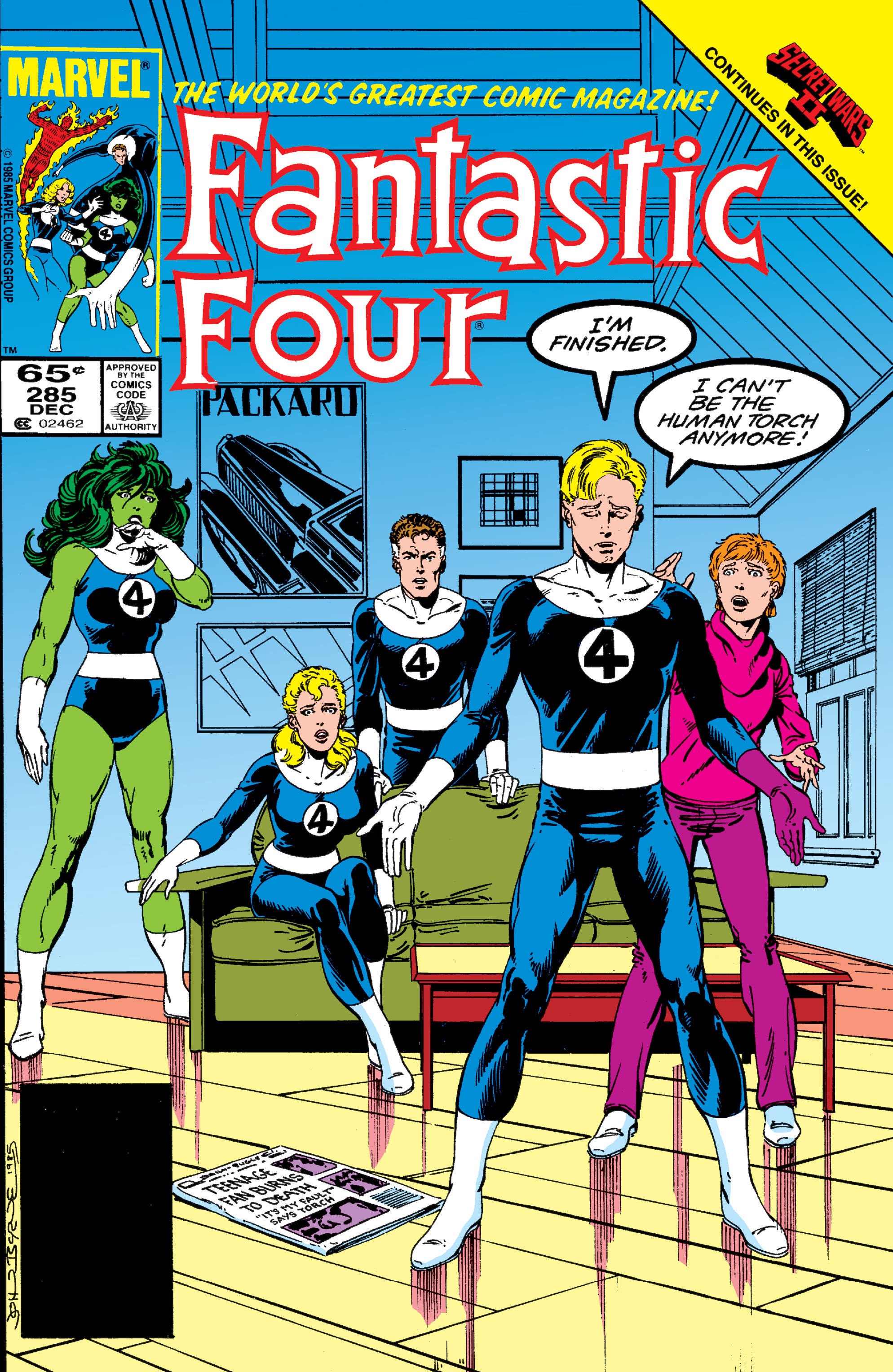
Now that we’re all on the same page, here’s where I must admit one huge great caveat to my screed: for all of its manifest terribleness, Secret Wars II did deliver what is easily my favorite Human Torch story ever written. Unsurprisingly, it came during John Byrne’s run on The Fantastic Four. (I wouldn’t learn until years later, however, that this issue wasn’t originally written to be a a Secret Wars II tie-in; the editors simply forced it to be. But that changes nothing.)
Our story begins with young Tommy Hanson, a lonely and awkward outsider who is terribly neglected by his parents and relentlessly bullied at school. Some of his teachers try to help him, some don’t. But what holds Tommy together is his obsessive love for superheroes in general, but one in particular: The Human Torch.
Pretty quickly, we can see that Tommy’s love for the Torch is an unhealthy one, but nobody around him seems to want to intervene. Bullies use it as leverage against him. Teachers see it as a prompt for more discipline. School administrators deem it worthy of a trip to the office, but nothing more. And the parents? Well, the parents are so absent that they don’t even enter the story until it is far, far too late.
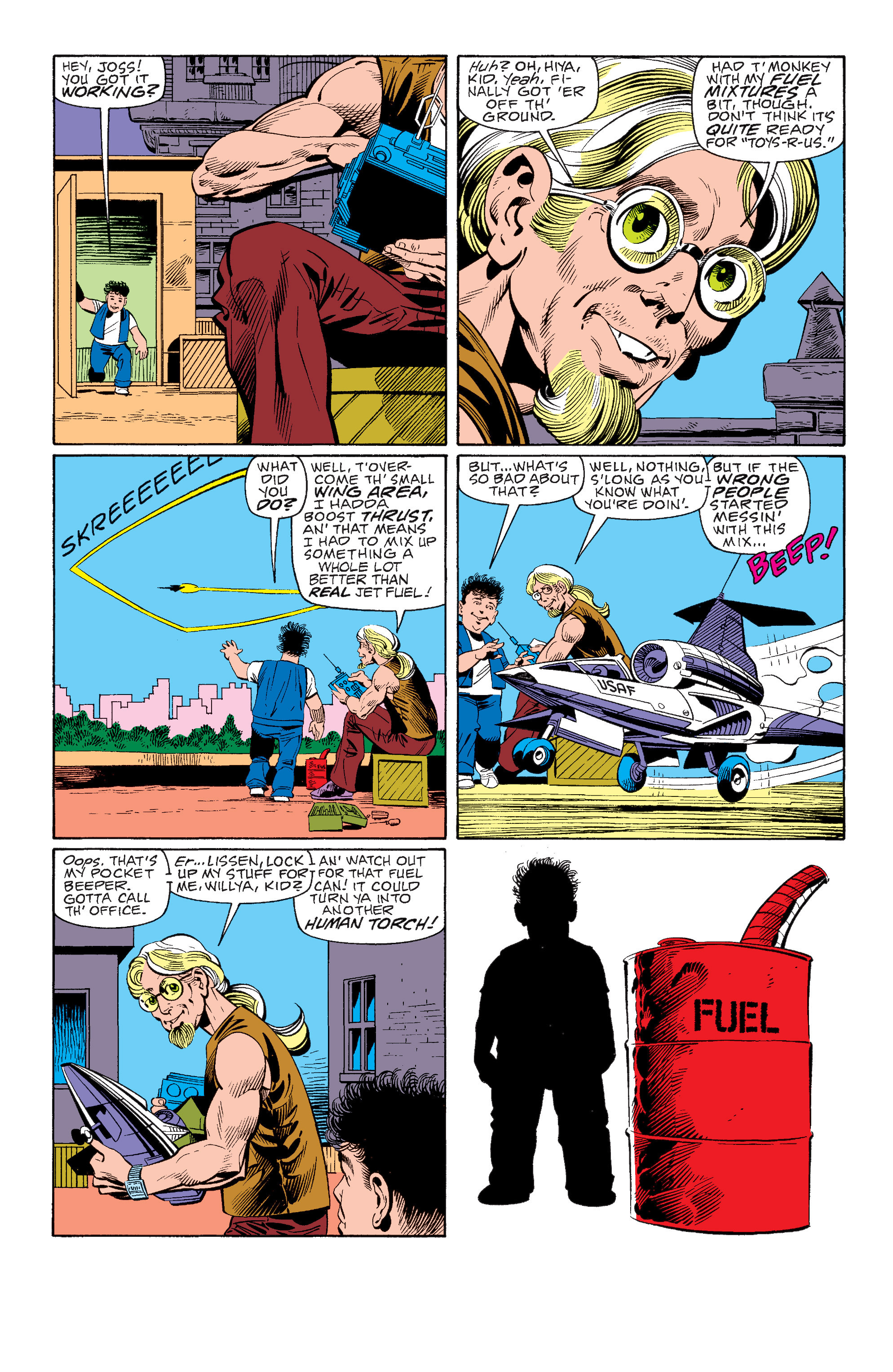
We follow a typical day in Tommy’s life, where a bad day at school ends up with yet another latchkey afternoon (and night). He encounters a local tinkerer named Joss who has built an experimental RC plane that runs on a really dangerous and illegal fuel blend. Called back to work, Joss departs the scene but not after asking Tommy both to put away his little jet-plane and jerrycan of illegal fuel, issuing a particularly on-the-nose prophecy, even for Marvel comics:“Watch out for that fuel can! It’ll turn you into a Human Torch!” Byrne gives us a single, ominous frame of Tommy and the can, and we can imagine the rest.
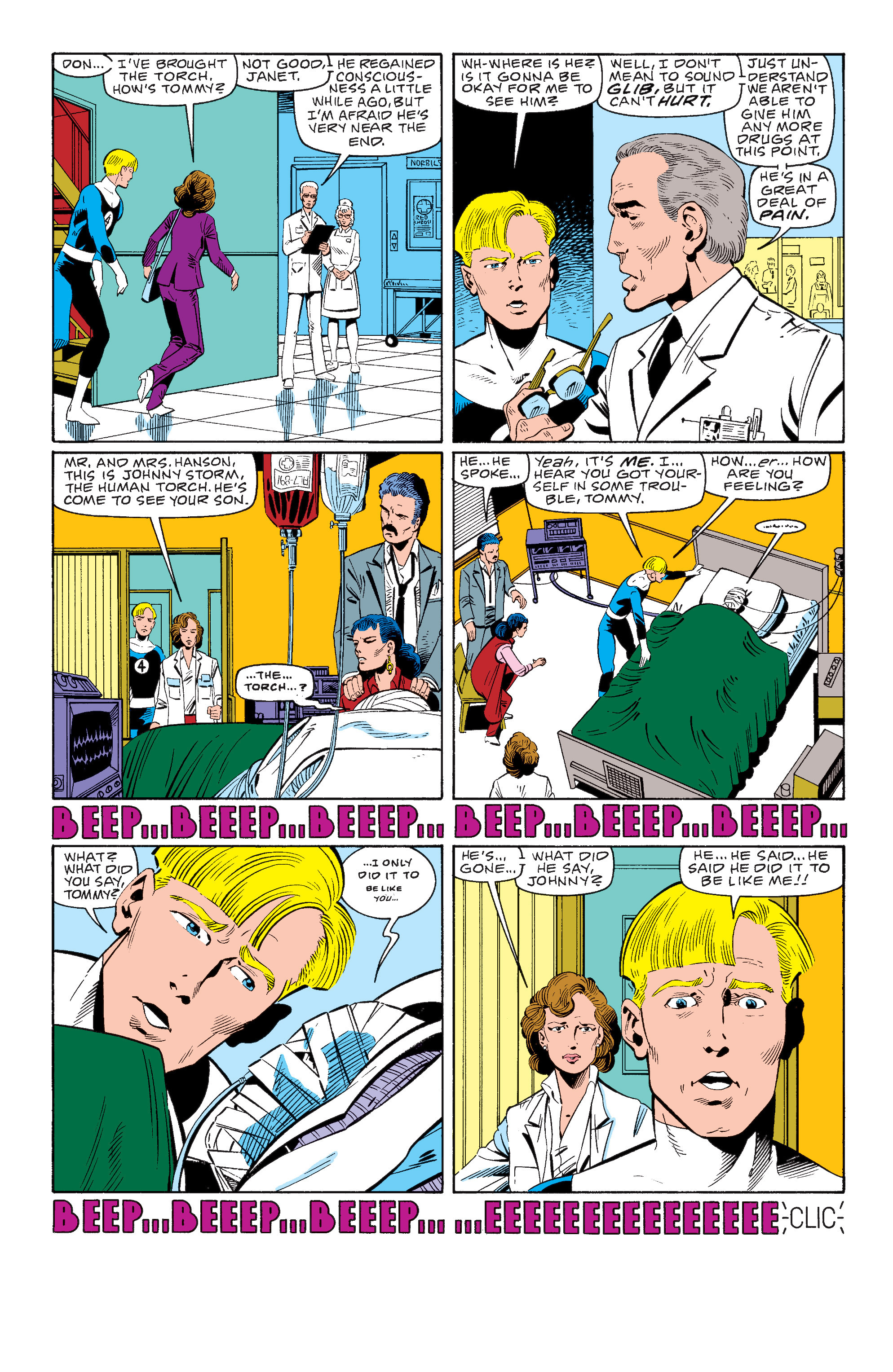
Johnny Storm only learns about this when a doctor from the burn unit reaches him a month later with news that the boy has asked for him specifically. When Storm gets there, he swiftly learns that Tommy only has moments left to live. Johnny bows down to speak with Tommy only to hear the boy whisper, in his final words, that he set himself on fire to be more like his favorite hero.
Tommy’s parents instantly vilify Storm with the kind of fury that can only be summoned by the sort of Boomers who would chronically neglect their kid and then wonder why things haven’t magically turned out just fine. You know, the kinds of parents for whom the government had to make PSAs throughout the 70s and 80s reminding them to actually put in the work of parenting. The kinds of parents for whom the Satanic Panic—which was in full swing when this comic came out—was a welcome scapegoat to distract themselves from the inconvenient truth that they were, in fact, terrible people with a contact allergy to accountability.
Johnny Storm is cut from a different cloth, and immediately internalizes what’s happened, to the point where he’s ready to forsake his powers entirely. Saving the world doesn’t mean the same thing if it involves inspiring confused young children to immolate themselves. That’s when the omniscient Beyonder shows up in Capra-eqsue fashion to show Johnny a vision of Tommy’s life—one in which the boy’s only moments of happiness were when he was fixating on his hero. Through the Human Torch, Tommy Hanson got whatever happiness he was ever going to get. And that wasn’t on Johnny Storm, even if Johnny himself was willing to carry that weight.
Growing up as a Gen X latchkey kid who dodged roving bands of bullies, spent free-range afternoons with zero oversight and found no small wonder in comics and RPGs, Tommy’s story has always resonated with me. And so has Johnny’s. It doesn’t take a hero to externalize their impact on the world and take accountability for things they don’t have to accept. It just takes a good person. And it was here that despite all of his recklessness, womanizing, and juvenile antics, Johnny proved in this one issue why he’s worthy of his uniform. And it wasn’t by nova-blasting some bad guy or blazing through the sky. It was by accepting the responsibility for a dead child even when every other adult who should have, wouldn’t.
Thanks for reading! This series unpacks my journey as a fan of superhero comics and how it led me to write my novel Omega Reign, in which a guilt-ridden, grief-stricken superhero must face his past if he has any hope to save the world. The Kickstarter for this action-packed tale of loss and redemption is live now. Please show your love for indie publishing—grab a free PDF of Chapter 1 and backing details here. Thanks for your support!